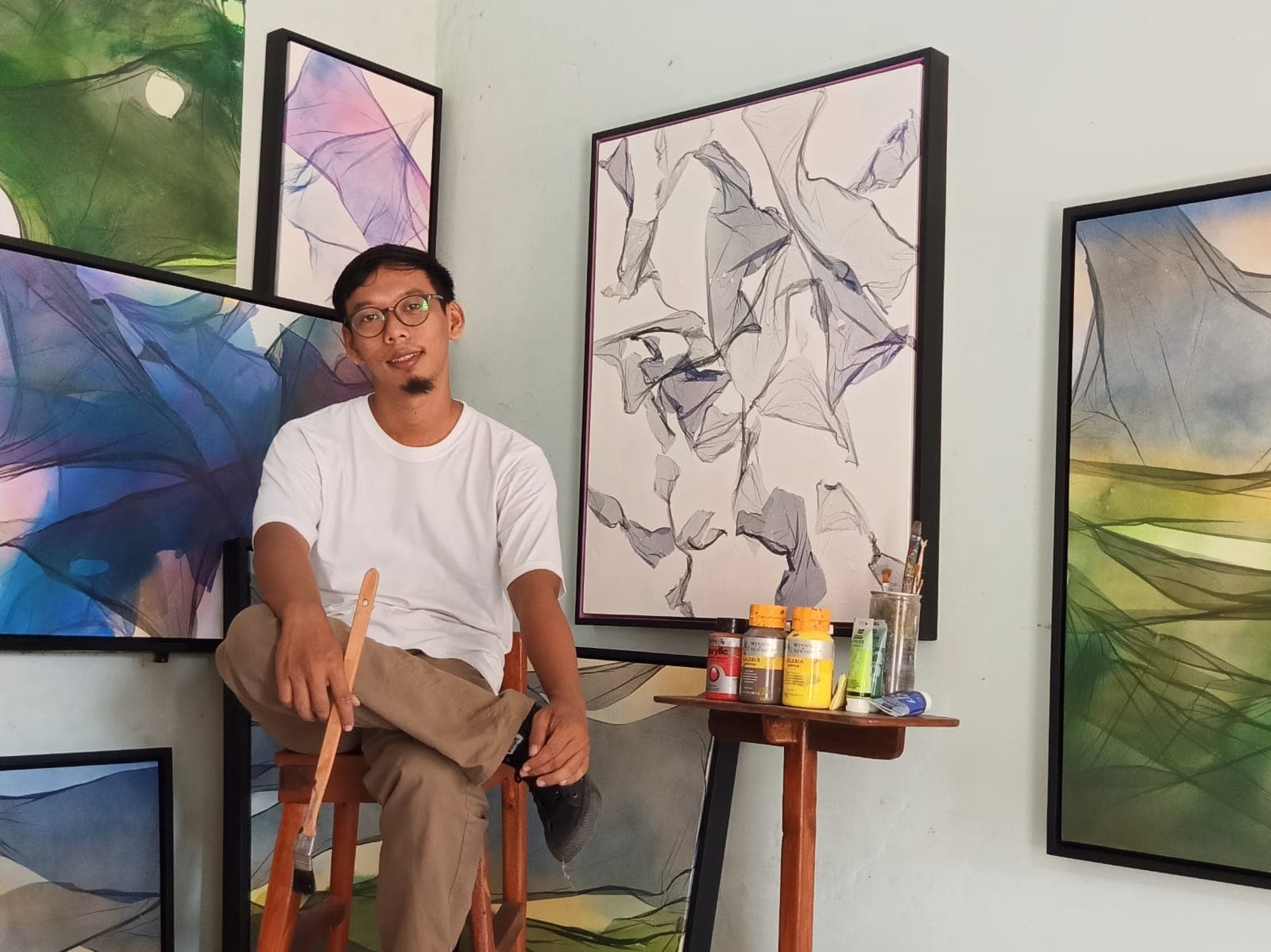
Akbar “Awa” Warisqia paints in acrylic on canvas, yet his surfaces resist that fact at every turn—rendered in an illusory visual language that reads, convincingly, as carpet and embroidery. This deception is not a technical exercise but a return: Awa grew up watching his mother work as a tailor, and the intimacy of that childhood, so intertwined with fabric, thread, and repair, remains the foundation of his painterly vocabulary. His works occupy the space between memory and invention, translating a familiar domestic craft into an unexpected pictorial language.
Central to that memory is the act of mending. In his household, a torn garment was patched and embroidered rather than discarded. It is a habit that Awa has come to read as a quiet form of optimism, the belief that what is repaired can become better than what it replaced. That sentiment now drives his imagery directly: suns and mountains recur throughout his paintings as symbols of hope and the capacity to grow.
To achieve the illusion, Awa draws on the Pointillist tradition of Georges Seurat and André Derain, adapting it toward an unusual end. He first builds the canvas from a field of dots that mimics the woven texture of a carpet, then layers in consistent vertical strokes that replicate the raised, stitched quality of embroidery. The result asks to be read as textile before it is recognized as paint, which then becomes a discovery that lands, for the viewer, as a small and deliberate surprise.
